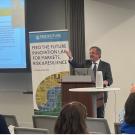
In this conversation, John elaborates on key takeaways from the studies, methods for collecting data amid a shock, and different ways of measuring resilience. He also discusses quandaries around allocation of limited resources—such as whether programs should use limited funds to maximize reach or focus on impact among a smaller group, and what balance of specializing vs. self-provisioning is best amid the quest for economic development in a shock-prone world.
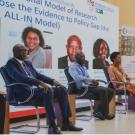
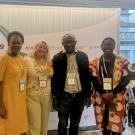
ICED's Evidence to Action (E2A) conferences, which gather researchers from across Africa, provide an ideal opportunity for ALL-IN capacity strengthening and knowledge-sharing activities. This year, special sessions with ALL-IN principal investigators before, during and after the conference included MRR Director Michael Carter's training on resilience measurement.
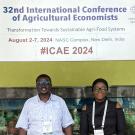
Every three years, the International Association of Agricultural Economists (IAAE) holds its flagship conference, the International Conference of Agricultural Economists (ICAE). Ten MRR-affiliated researchers presented at ICAE 2024, many sharing their MRR-funded work.
MRR projects are using rigorous research methods to test whether and how ICT solutions can be an effective way to: provide information to dispersed populations; improve market efficiencies for farmers; and reduce basis risk in index insurance.
ALL-IN principal investigator, Fred Dzanku was focused on the shea value chain to reduce poverty for women in Northern Ghana. Through his work, he realized that rural financial transactions were a key bottleneck. He was able to secure resources from a Gates-funded research initiative to onboard a rural community bank to a digital payments platform and conduct research around women's uptake.
Three MRR / ALL-IN researchers presented at the 2024 ICTforAg conference in Washington, D.C. They discussed their research around agro-weather advisories, picture-based insurance, and digital literacy in Kenya and Nigeria.
PI of a 2014-2016 Innovation Lab project, Hope Michelson returns to discuss results of a follow-on study, as well as her latest thinking around the African soil and fertilizer landscape. Hope identifies constraints that must be addressed before we’ll see widespread farmer demand for soil tests, and she considers whether there might be a “good enough” geographic scale for soil testing.
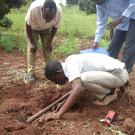
If farmers learn that their soil is acidic, applying agricultural lime can dramatically increase their yields. However, data collected among smallholder farmers in Kenya indicates low frequency of soil testing and an unwillingness to pay current market prices for the service.
Recently, two studies supported by the MRR Innovation Lab have measured the impact of agricultural interventions after their end. One, in Bangladesh, is structured as a traditional ex-post evaluation that measures the impact of a program that was designed with a randomly selected treatment group. The other, in Uganda, takes a novel approach in measuring the effect of program end on groups randomly selected for phaseout.
On February 27 and 28, 2024, the MRR Innovation Lab hosted the Behavioral Economics Forum: Lessons to Strengthen Development Programming and Policy. Local participants convened at USAID offices in Washington, D.C., joined by over 120 online participants from around the world.